

In-Depth Guide to Rebranding a Nonprofit

Nonprofits often delay investing in their message and image because they feel like their mission’s needs are more important. Rebranding can feel like a daunting and expensive undertaking, but it doesn’t have to be. By approaching the process in a slow and methodical way, nonprofits can spread out the cost of a rebrand and establish a deeper connection with their audience.
Catholic Charities of Middle Tennessee came to me in mid-2019 to begin the rebranding process, and in early 2022 are still updating as needs arise. They had a desire to do a slow rebrand in order to keep costs in check and not shock their audience. In other words, they wanted an evolution, not a revolution. Below I will take you through each step of their rebrand.
“Jenni’s work on reimagining the visual identity for our agency was invaluable. And then to top it off, she developed the brand standards book to guide us in usage. It is a triumph! I am thrilled with our new look and the renewed energy it helps give to the whole organization.”
When Should a Nonprofit Rebrand?
Time
If it has been more than seven years since you touched your brand visuals or messaging, now is the time for review. In the case of Catholic Charities, they had had the same logo and website for ten years and were ready for an update.
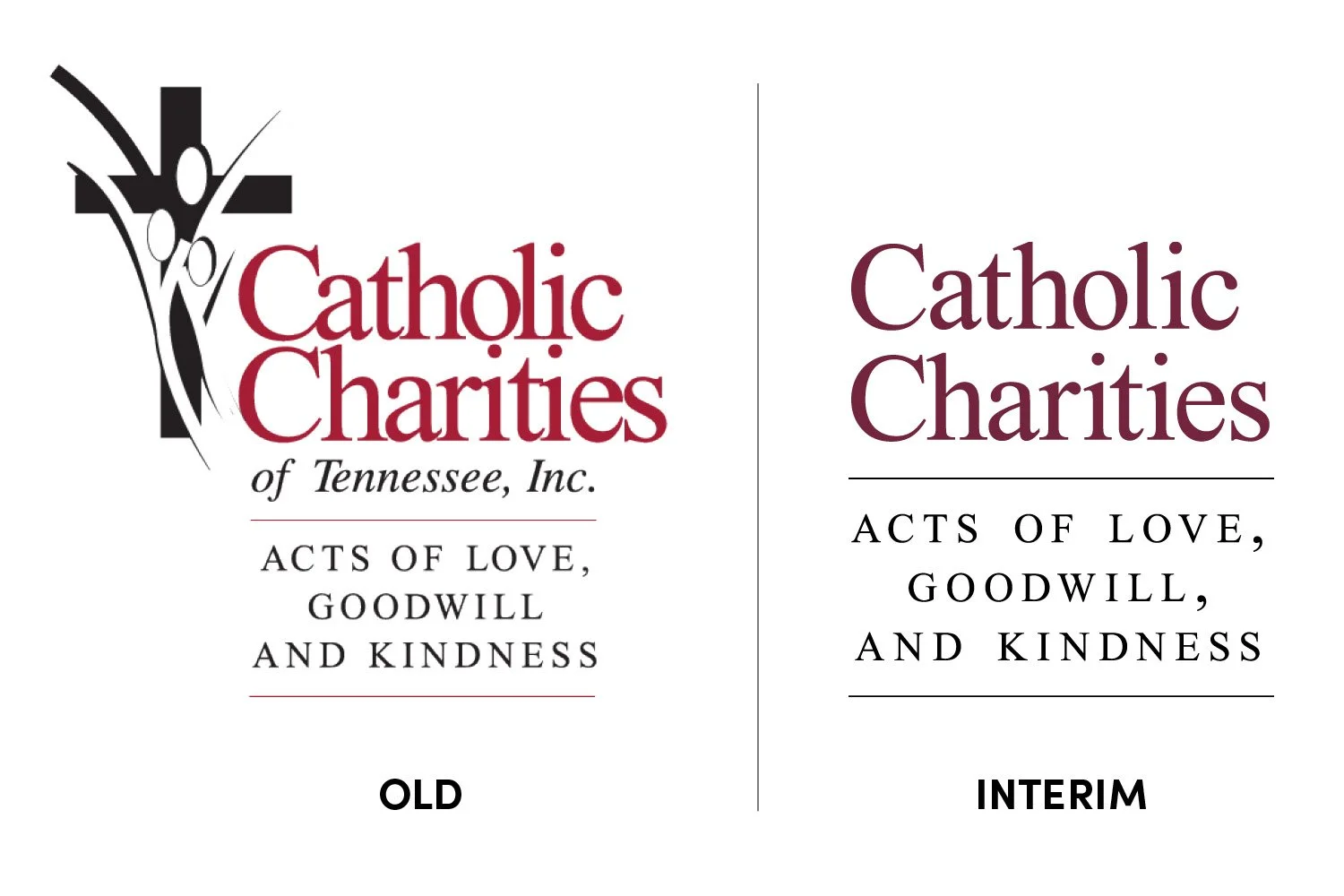
Catholic Charities felt their current logo was hard to read and their cross imagery was not well done, so I did a quick revision to give them a placeholder while the next phase of the rebrand happened behind the scenes. I loosened the spacing between the letters and removed the crucifix imagery.
Outdated Messaging
Sometimes an organization’s messaging gets out of sync with its current audience. Your mission may have evolved over the years, or maybe you have different goals than you did ten years ago. In the span of a decade, other nonprofits may have entered your arena and you need to differentiate yourself. A holistic rebrand focuses first on your underlying brand strategy and makes sure it aligns with your current values, goals, and audience.
Catholic Charities’ previous logo caused confusion, as it referred to the organization as Catholic Charities of Tennessee when in reality there are also Catholic Charities in both East and West Tennessee. We changed the subhead to Diocese of Nashville, which is the community they support. Through introspection and discussion, they also changed their tagline from “Acts of Goodwill and Kindness” to “Love, Hope, and Healing.”
How to begin a rebrand
Introspection
Before embarking on a rebrand, take stock of where you are currently and the goals you are aiming for. Some questions to ask internally to clarify your vision:
What’s the problem we are here to fix?
Why does that matter, now?
What are we doing about it?
What do we want others to do?
The next step is deciding whether you are looking for a full rebrand (new logo, possible new name, updated messaging, new website, etc.) or a partial rebrand (tweaking current logo and messaging, new marketing materials). A full rebrand can be invigorating and give new life to an organization, especially if you are planning to pivot to new areas of need. It can also be expensive and jarring to your audience if not handled well. A partial rebrand can be implemented slowly over time, but may not be enough to be noticed if the changes are too subtle. A brand strategist can help you navigate these questions and guide you on the best path forward.
Catholic Charities’ goal was to refocus their messaging, implement a new, more polished wordmark and updated website to start, then expand to new signage, stationery, and marketing materials as the need arose.
Building a Team
Once you have established a direction, it is important to involve a variety of stakeholders from your organization. Internally, you should aim to involve several Board members, staff, donors, volunteers, and former clients if applicable. Not all members should have decision-making power, but by involving them in the process, they will become ambassadors for the rebrand, and can offer diverse perspectives on messaging. The CEO or head of communications/marketing should have the deciding vote and be the point person for your brand strategist and designer.
Nonprofit Brand Strategy
Brand Map
All organizations need to clarify their core message from time to time. A rebrand is the perfect opportunity to dive deep into what you value most, your why. My strategy sessions can take up to two hours, and for a nonprofit, I’d recommend involving 1–3 of the top stakeholders in the conversation. The results are compiled into a brand map which includes your ideal audience of clients and donors, competition audit, your brand voice, brand personality, and a few image and type moodboards to show a direction for the visual aspects of the brand.

Catholic Charities’ new tagline (“Where there is need, we bring love, hope, and healing”) provided a framework for their brand strategy. They believe not only in providing immediate help in an emergency, but in offering their clients the resources they need to become more resilient in the face of adversity.
Nonprofit Brand Design
Brand Identity
Once a strategy has been identified, it is much easier to move on to visualizing your values. Approved type and image moodboards give an idea of what direction the visuals will take, one that emerges directly from the brand strategy. After extensive visual exploration, I offer a single, strong concept to the client, which we can then refine. You will see a suite of branding mockups to give you a feel of how the logo or wordmark will look in real life on signage, promotional items, stationery, etc.

Once the visuals are approved, I provide a comprehensive set of Brand Guidelines that includes imagery style recommendations, primary and secondary type and color palettes, as well as guidelines for your logo variations. This can be utilized either by an in-house or contracted marketing and design team.
How to Launch a Nonprofit Rebrand
Spreading the News
Raising awareness about your rebrand should be its own strategy. Keeping the rebranding stakeholders informed as the process moves along is very important, but at this point, you need to expand beyond your chosen team. Your board and top management will appreciate an in-person meeting to go over the specifics and timeline of your launch.
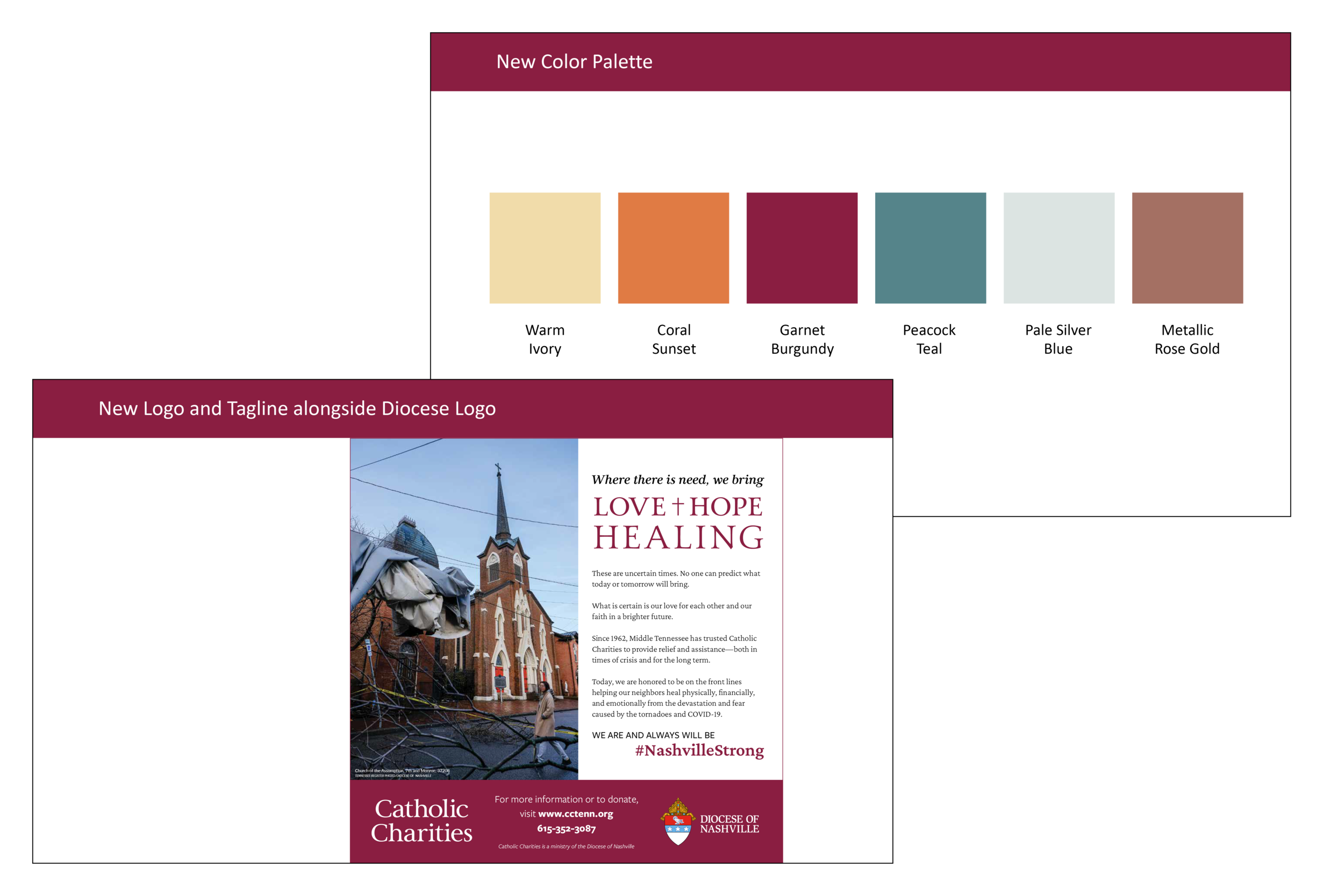
I worked with Catholic Charities to design a presentation that could be used to present the updated branding to the Board and staff in order to get them excited about the new direction. When brand guidelines are finalized, share them far and wide within your organization, because consistency at all levels is key.
Website
A new website announced through email and social media can be a good way to reveal your new branding to your established audience. If your nonprofit is prominent within your community, consider press releases to inform the general public. Sometimes a video is necessary if it is a radical change to better explain your vision and goals and how the new brand will help your organization achieve them.
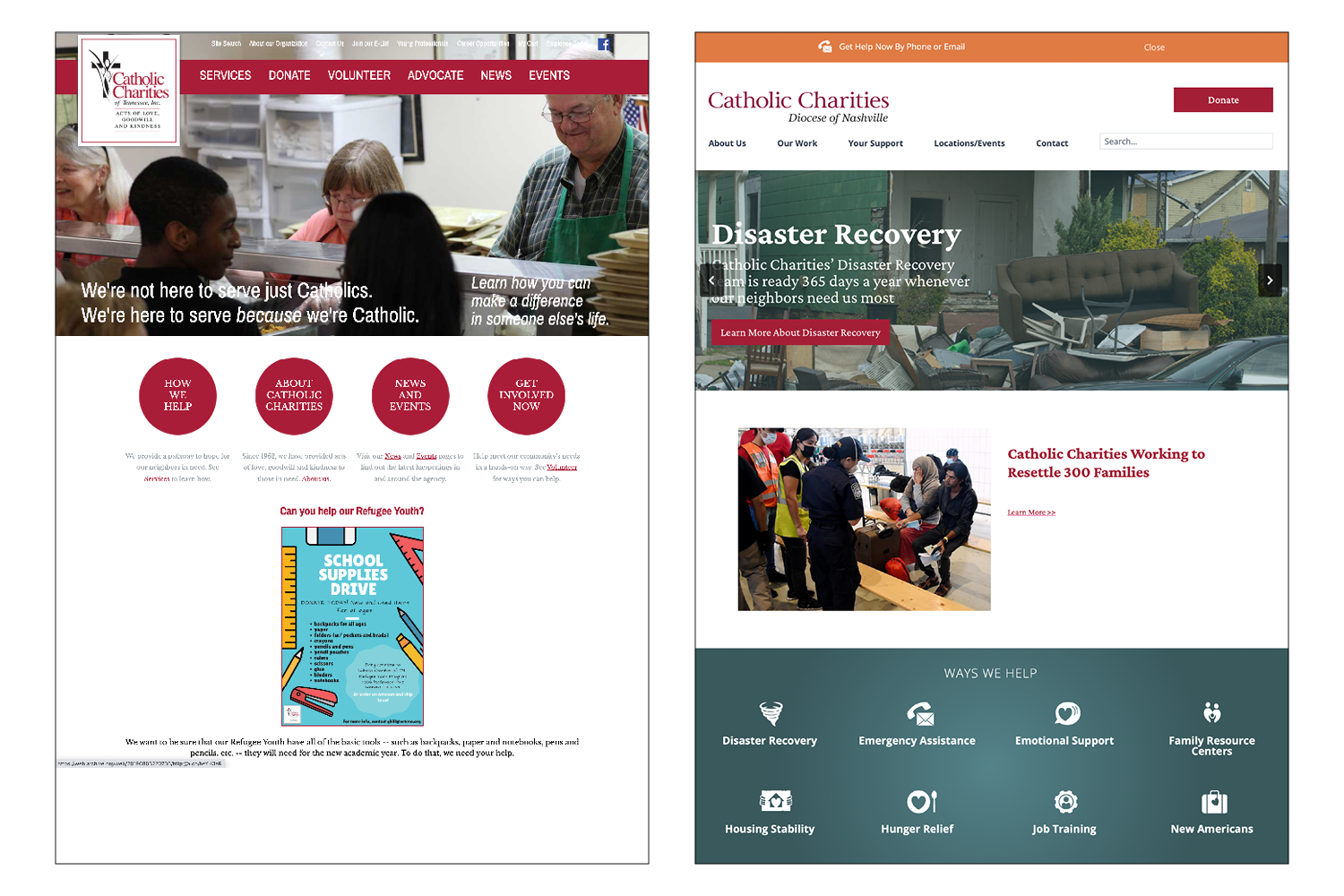
The structure of Catholic Charities’ website had not been touched in 17 years, so it was redesigned from the ground up. The developer and I worked together with the client to reimagine a structure that would best serve their audience. I designed a set of icons to represent the different areas of need they serve and worked on the general look and feel of the site, as well as new email and social media templates.
Brand Collateral
How quickly you implement your branding within all corners of your organization depends on how radical a change you are making, and of course on budgetary considerations. Some of the most common items to update are business cards and stationery; signage; brochures and mailers; templates for advertising, social media, email, and presentations; promotional items; exhibit booths; and banners. Even with the most radical rebrand, most of these can be implemented as they are needed. What is helpful is to have as many templates made as possible, so that when you add a new employee or need to announce a new initiative, business card template designs are already with the printer and a social media template is ready to plug and play.


For Catholic Charities, we began with stationery. New business cards were printed for top management, with templates at the printer ready for future use. I designed new templates for brochures and presentations as the need arose within different departments. Updated signage was produced for new locations, but old signage was left in place.
As much as I advocate for paying as you go to get your new brand in place, leaving too many visible reminders of the old brand can be confusing for your audience, so try and budget to replace those that are public-facing as soon as possible. Beyond visuals though, the most important part of your rebrand is consistent communication based on your identified brand values, voice, and personality listed in your new brand guidelines.
Conclusion
In summary, if your nonprofit has fallen out of sync with your audience due to outdated visuals or scattershot messaging, it may be time to invest in a rebrand. Pull a team of stakeholders together to talk about your current strengths and weaknesses, and evaluate your goals in regard to a rebrand. Consult with a branding expert to nail down your organization's core values and develop a communication strategy. Once your strategy is in place, it can be used as the foundation for new visuals. With new branding and guide in hand, develop a plan for the launch and implementation.
Catholic Charities has been reinvigorated with a focused strategy and consistent visuals. After seeing the first of the new designs, staff have excitedly requested new marketing materials for their departments. Board members have commented on the new visual sophistication, and donations have increased at all levels.
Rebranding your nonprofit can be a major commitment, but it is also an exciting opportunity to reevaluate your priorities and messaging. Implementing a communication plan based on your organization’s values is a sure way to increase engagement with old and new donors, clients, and the public. Combining consistent messaging within a new visual framework is a sure recipe for success!
